Internal material handling in steel service centers, metal processing facilities, and stamping mills demands millimeter precision and rigorous load stability. The central challenge lies in the nature of the cargo: coiled sheet metal concentrates tons of weight into a dense, cylindrical geometry.
Across industrial yards, it remains common practice to move these coils using standard forklift tines—either spreading them into a "V" cradle or inserting both forks directly into the coil's core. This maneuver causes direct financial scrap and exposes handling equipment to severe mechanical fatigue.
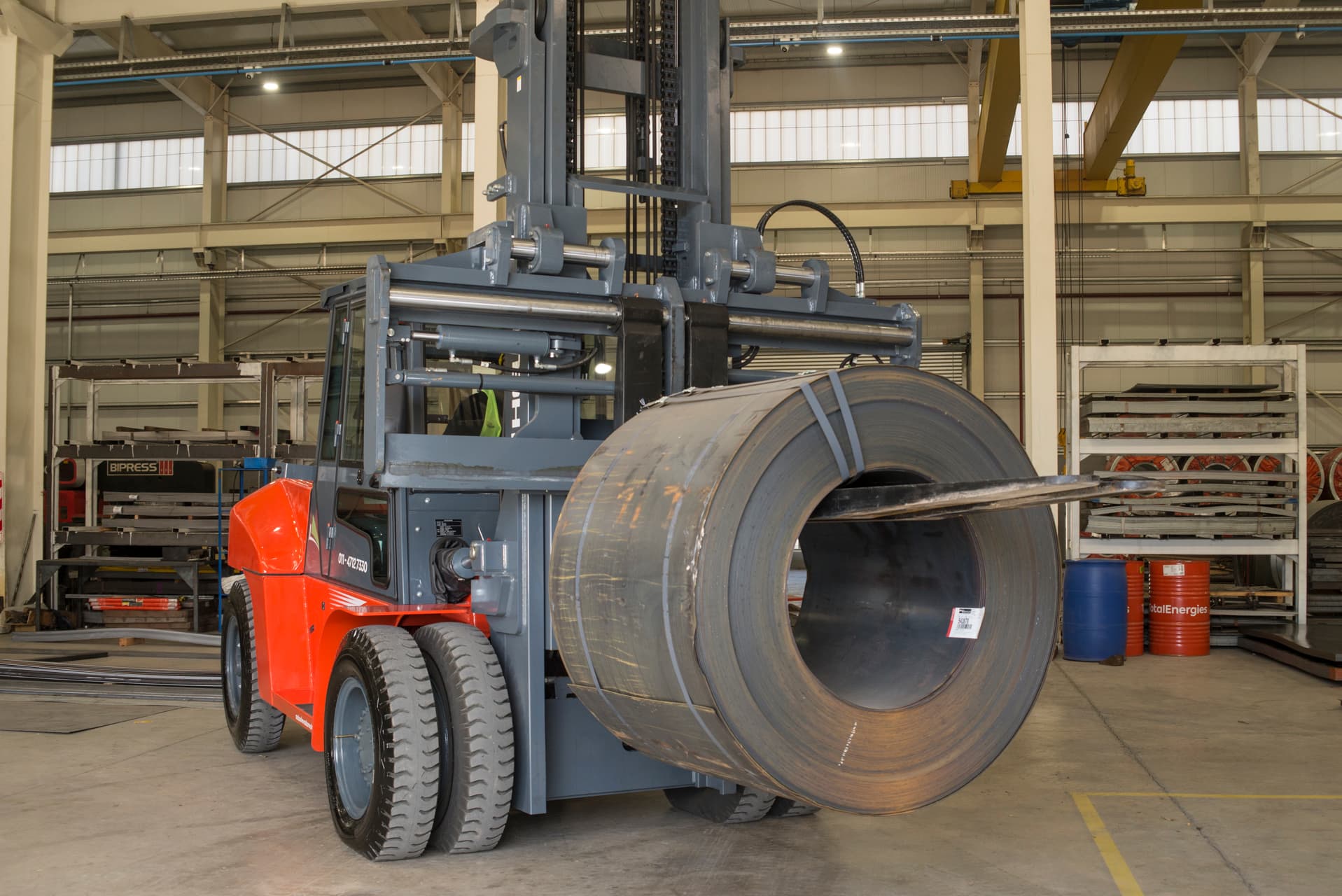
The engineered solution for this application is the dedicated coil ram attachment (boom). Below, we analyze why this attachment is essential for steel handling operations.
1. Eliminating Sheet Deformation and Material Scrap
Standard forged steel forks feature flat surfaces and square edges designed to engage beneath wooden pallets. When applied to lifting a coil through its core, the entire tonnage concentrates along narrow contact points.
The problem with forks: Point-loading against the coil's inner circumference gouges, creases, and bends the innermost steel wraps. On light-gauge sheets or finished coils, this ruins initial layers, generating costly scrap before reaching the slitters or blanking presses.
The coil ram solution: A coil ram consists of a solid, cylindrical steel shaft designed to match the coil's inner radius. Without sharp edges, the load weight distributes uniformly across the upper curvature of the ram, keeping prime metal unblemished.
2. Center of Gravity Stability and Roll Prevention
Transporting cylindrical cargo introduces dynamic roll forces during acceleration and braking cycles.
Roll hazard: When carrying a coil perched on open tines, sudden braking or floor irregularities can cause the roll to shift forward, dislodging from the forks.
Load center control: A coil ram passes completely through the axial center of the coil until it seats flush against the heavy-duty carriage backrest. This through-bore engagement eliminates roll hazards, anchoring the load's center of mass close to the drive axle.
3. Structural Protection for the Mast and Fork Carriage
Forklift masts and carriages are engineered for balanced, downward vertical loads across two contact points.
Torsional stress: Lifting high-tonnage coils on spread forks or a single tine creates uneven, off-center torque. This twists the fork carriage, stresses mast channel bearings, and causes uneven wear across lift chains.
Heavy-duty integration: Coil rams mount centrally directly onto the forklift's carriage plate (Class III or IV, depending on equipment capacity). Lift forces transfer symmetrically through the main hydraulic cylinders and mast channels, extending component service life.
Conclusion
Tailoring attachments to load geometry preserves material integrity and optimizes operational cycle times. Equipping heavy-duty forklifts with a dedicated coil ram eliminates scrap from coil gouging while preventing mechanical strain on the lifting structure.
To review high-capacity forklift models and application-specific attachments, explore our lineup in the products section or contact our team directly through our contact section.
Share
The Interlogistic Team
Specialists in industrial logistics and equipment