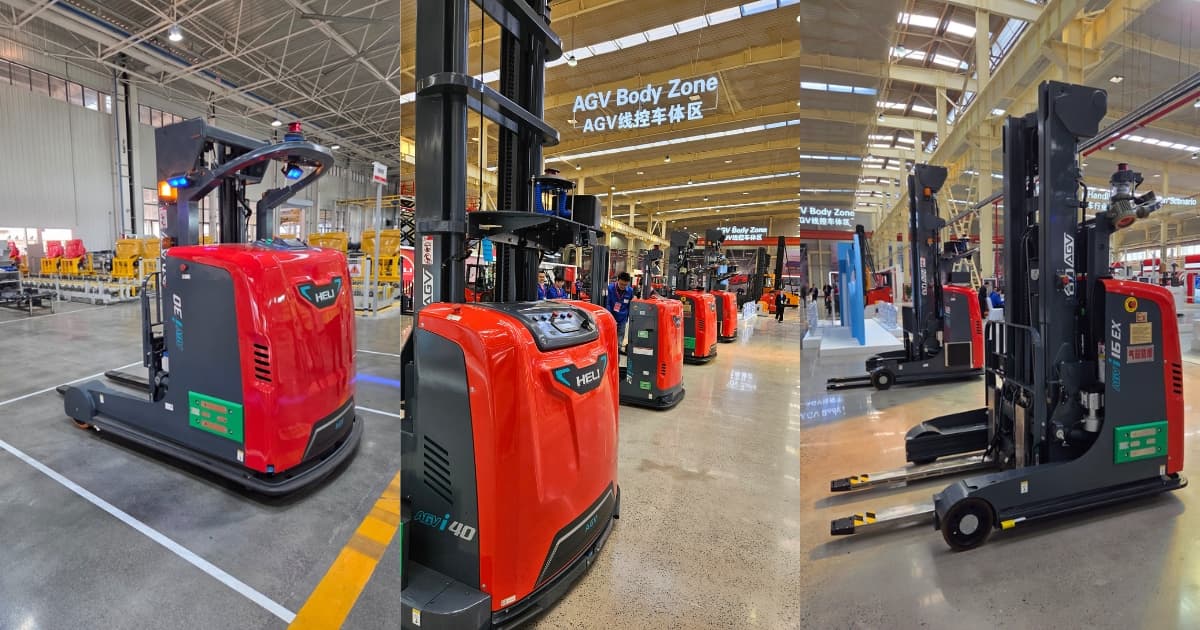
The evolution towards Intralogistics 4.0 requires distribution centers to move away from exclusively manual handling models and integrate solutions that guarantee a constant and predictable merchandise flow. The incorporation of Automated Guided Vehicles (AGVs) is no longer a pilot test; it has consolidated as the operational standard in high-turnover facilities.
Modern AGV equipment, such as autonomous stacker and reach truck lines, are designed to take on repetitive and continuous-cycle tasks, freeing up technical personnel for more complex operations. Below, we analyze the technical capabilities that allow this technology to transform warehouse profitability.
1. Smart Navigation Without Infrastructure Modifications
The main historical barrier to automation was the need to alter the floor with magnetic tapes or rails. Current AGV systems eliminate this cost and structural rigidity:
LiDAR Mapping and SLAM Technology: Through laser scanners located at the top of the equipment, the machine reads the environment and builds a real-time three-dimensional map. This ensures natural and adaptable navigation.
Layout Flexibility: If the distribution center needs to modify its aisles or relocate storage zones, the equipment's route can be digitally reconfigured in minutes from the control software, without halting plant operations.
Millimeter Positioning: The combination of optical sensors allows for exact approaches to the racking, ensuring the lifting and placing of pallets without deviations, which is crucial for high-level stacking.
2. 360° Active Safety and Operational Coexistence
Integrating autonomous machinery requires absolute guarantees for both personnel and infrastructure. AGVs operate under redundant safety protocols:
Dynamic detection shields: Front and side radars continuously scan the perimeter. The equipment automatically reduces its speed upon detecting a distant operator or manned forklift, and applies an emergency brake if the obstacle enters its critical radius.
Trajectory light projection: Using LED safety lights (such as Blue Spot or Red Zone systems), the vehicle actively signals its direction of travel on the floor, visually warning personnel at blind aisle intersections.
Automated stability control: The machine's processor calculates load weight and mast height to adjust travel and turning speeds, eliminating the risk of tipping over due to miscalculation during maneuvers.
3. Efficiency in Repetitive Tasks and 24/7 Workflows
Uninterrupted work cycles: Ideal for two or three-shift operations. By eliminating human fatigue during long hauls such as moving pallets from the production area to the dispatch buffer a constant delivery cadence is maintained.
Inventory traceability: Every movement executed by the AGV is reported in real time to the Warehouse Management System (WMS). Human error in location logging is eliminated, guaranteeing exact stock control.
Conclusion
Integrating AGV technology on a global scale demonstrates how robotics empowers the workforce in repetitive tasks without replacing human judgment. Analyzing the evolution of these technologies helps project where intralogistics is headed and what efficiency standards will define future operations.
If you are looking for guidance on how to optimize the productivity of your active fleet, you can reach out to our team through the contact section.
Share
The Interlogistic Team
Specialists in industrial logistics and equipment
.jpg&w=3840&q=75)