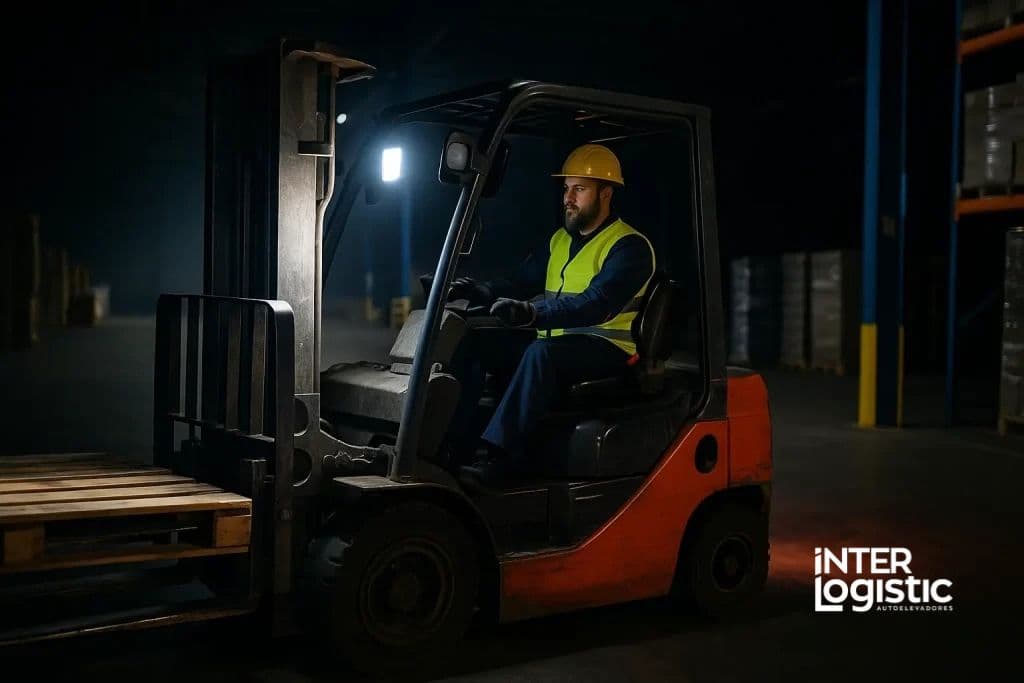
Sustaining two- or three-shift daily operations requires maintaining the same standards of precision and safety at 2:00 PM as at 2:00 AM. During the night or in storage areas with little natural light (such as the interior of semi-trailers or containers), depth perception decreases, increasing the risk of scrapes against racking or imprecise maneuvers when lifting pallets.
Equipping your fleet with a proper lighting system is crucial for protecting operator visual health and preventing incidents. Below, we review how modern lighting technology applied to forklifts solves night operation challenges.
1. LED Front Lighting and Visual Fatigue Reduction
Old halogen lights produced a yellowish, diffuse light that strained the driver's eyes and consumed a considerable amount of energy:
Daylight tone (neutral white): LED headlights on the HELI line project a clean light that mimics daylight, improving load clarity and aisle label reading without dazzling pedestrians or other operators.
Focused beam pattern: Designed to directly illuminate the fork work area and driving path, eliminating blind shadows when positioning loads at high elevations.
Reduced eye strain: By minimizing constant focusing effort, drivers maintain steady concentration throughout the night shift.
2. Blind Spots and Maneuvers Inside Trailers
Loading or unloading a truck at night involves transitioning from a brightly lit staging area to the dark interior of a semi-trailer in seconds:
Rear and side work lights: Ensure that reversing out of a dock bay maintains full visibility throughout the turning radius.
Proximity signaling (Blue Spot / Red Zone): On night shifts where ambient noise drops but foot traffic fatigue increases, projecting light beams or perimeters onto the floor is vital to alert pedestrians before the machine emerges from a crossing.
3. Energy Efficiency and Operational Durability
In electric fleets, every ampere counts to extend battery autonomy during the shift:
Low electrical consumption: LED technology consumes up to 80% less energy compared to traditional incandescent lamps, preserving battery charge for the traction and lift systems.
Vibration resistance: With no fragile filaments, LED headlights withstand driving vibrations on outdoor yards or uneven floors without burning out, eliminating downtime for bulb replacements.
Conclusion
Adapting forklift lighting to 24/7 operational demands is a practical measure that directly impacts plant safety and night dispatch speed. Protecting driver vision is the best guarantee for maintaining a smooth, trouble-free workflow at any hour.
If you want to explore the safety and LED lighting options integrated into our machinery, we invite you to check out our HELI products catalog. To receive tailored advice on equipment configuration for night or intensive work, feel free to write to us through our contact section.
Share
The Interlogistic Team
Specialists in industrial logistics and equipment
.jpg&w=3840&q=75)