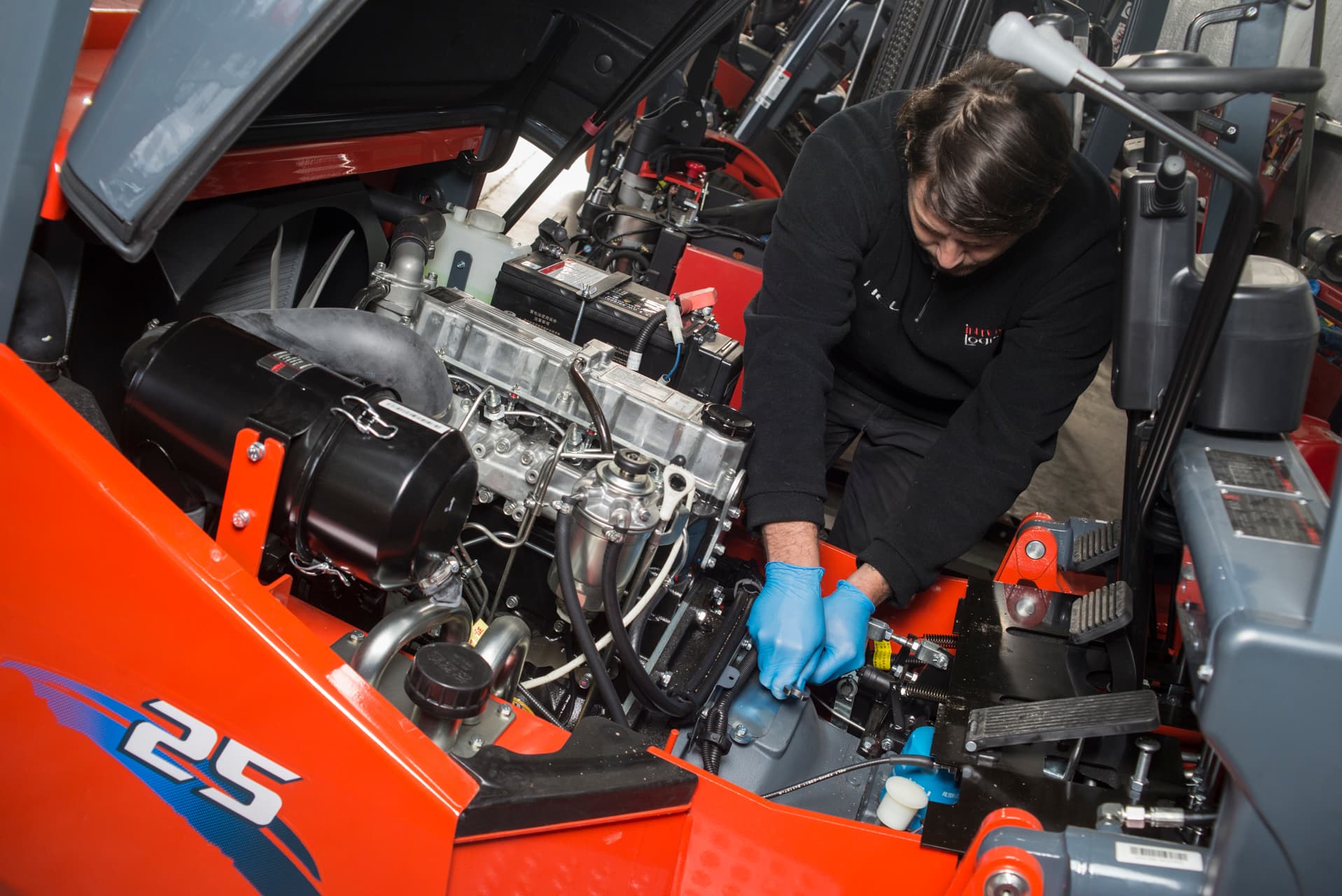
During the final quarter of the year, when warehouse operational rhythm reaches its peak, an unplanned breakdown of even a single machine disrupts the order fulfillment chain and causes delays at the loading dock. Most major breakdowns or minor operational incidents begin as minor faults that could have been detected in time through a five-minute visual and functional check.
Establishing a pre-shift control routine not only protects workflow continuity but also ensures compliance with current Occupational Health & Safety regulations. Below is the essential structure of an effective pre-operational checklist.
1. Static Inspection (With Equipment Powered Off)
Before starting the engine or turning the key, the operator must walk around the unit to verify the general condition of the chassis and structural components:
Fluid levels and leaks: Check engine oil (on internal combustion units), brake fluid, and hydraulic fluid levels. Inspect the floor underneath the equipment for recent drips or stains.
Mast, chains, and forks: Visually confirm that lifting chains have uniform tension, hydraulic hoses show no cracking, and forks exhibit no deformation or excessive heel wear.
Contact points and tires: Inspect tire condition (pneumatic or solid cushion), verifying there are no deep cuts, embedded objects, or uneven wear patterns that could compromise load stability.
2. Dynamic Verification and Safety Systems (With Equipment Powered On)
Once the static check is complete, proceed to start the machine to test control response and warning devices:
Signaling devices and lights: Test the horn, flashing beacons, reverse alarms, LED work lights, and safety projectors (such as the Blue Spot).
Lift and tilt controls: Operate the mast through its full free-lift range to check for smooth elevation and lowering, ensuring there are no abnormal noises or jerks in the hydraulic system.
Brakes and steering: Conduct a low-speed driving test to evaluate service brake response, parking brake engagement, and power steering precision.
3. Record-Keeping and Incident Reporting Protocol
A checklist loses its effectiveness if a discovered fault is not immediately routed to the maintenance department:
Signed control sheet: Every shift must begin with an hour meter reading and the signature of the operator responsible for the unit.
Immobilization criteria: If a critical fault is detected (major hydraulic leak, brake failure, or inoperative seatbelt), the machine must be tagged out and immobilized until technical service intervenes.
Preventing major wear: Reporting minor misalignments promptly allows for quick preventive intervention before they escalate into complex, costly repairs.
Conclusion
The pre-operational checklist is the simplest and most effective tool to protect your machinery investment and safeguard plant safety. Standardizing this daily routine enables operations to handle demand surges with a reliable, safe, and fully available fleet.
If you want to optimize your fleet maintenance plan or need advice on original spare parts availability, we invite you to explore our HELI product catalog. To schedule a preventive maintenance plan or request professional on-site assistance, feel free to contact our technical service team.
Share
The Interlogistic Team
Specialists in industrial logistics and equipment
.jpg&w=3840&q=75)