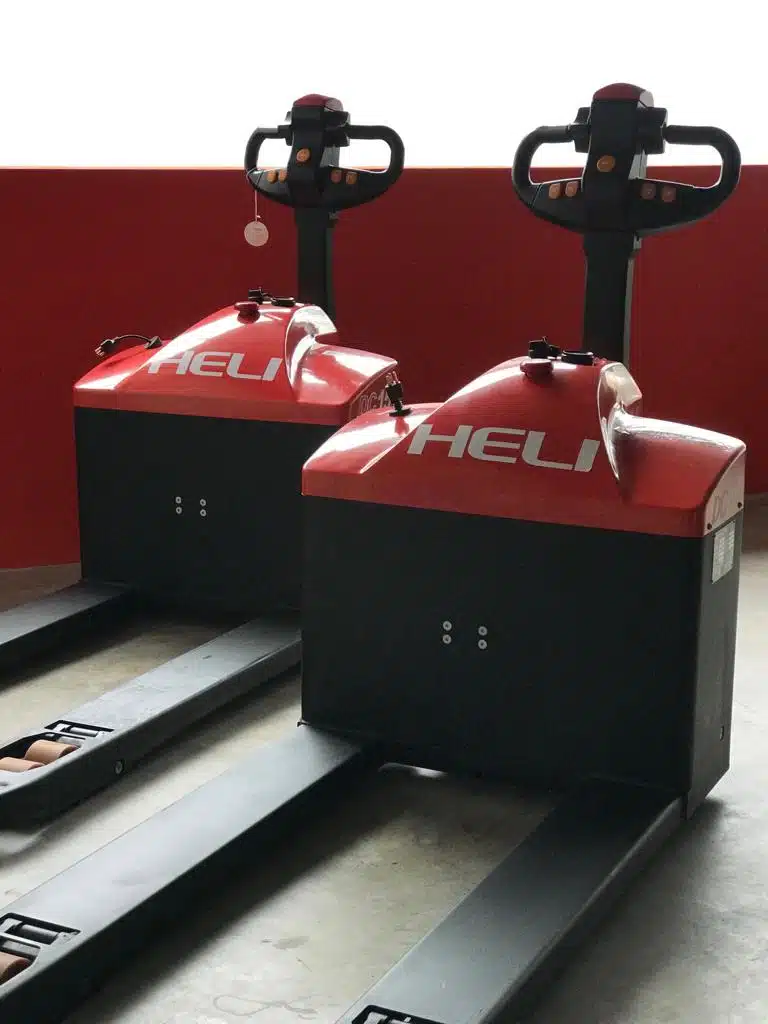
The pallet jack (also known as a pallet truck, transpaleta, or hand truck) is the simplest and most widely used piece of equipment in modern warehouses and distribution centers. Specially engineered for horizontal transport rather than vertical lifting, it is primarily available in two main versions: manual and electric.
These are extremely versatile tools that easily adapt to multiple daily operational workflows:
Loading and Unloading: They accelerate the loading and staging of pallets inside delivery trucks and containers.
Internal Transport: Ideal for short-distance material and bin movements at ground level.
Order Picking Support: They act as essential auxiliary equipment during item collection and order fulfillment processes.
Feeding Intake Zones: They transport loaded units to strategic warehouse staging points, leaving them ready for forklifts to pick up and place into high-tier racking.
Overall, pallet jacks represent an indispensable, low-operating-cost link that resolves bottlenecks across all storage areas. Below, we break down the characteristics of each model to help you select the ideal option for your fleet.
1. Manual Pallet Jacks: Simplicity and Durability
The manual pallet jack features no electrical or motorized components, meaning that all pulling, steering, and transport movements rely entirely on the operator's physical strength, who always performs the task on foot.
The tines (the parallel steel forks supporting the load) are raised slightly by manually pumping the handle, which engages a compact hydraulic pump. This small elevation is just enough to separate the pallet from the floor and facilitate its movement. Their utilization is widespread due to their near-zero maintenance costs, outstanding durability, and ability to maneuver in extremely tight spaces.
2. Walkie Electric Pallet Jacks (Pedestrian)
Unlike manual versions, electric pallet jacks incorporate electric motors to handle both load traction and automated low-level pallet lifting.
In this configuration, the operator walks alongside the truck but controls the machine without heavy physical exertion, thanks to ergonomic controls and built-in safety buttons located on the central steering tiller. They are the perfect alternative for medium-sized warehouses where travel distances increase, allowing operations to mitigate staff fatigue while accelerating the volume of moved tons per hour.
3. Rider Electric Pallet Jacks (Platform or Sit-Down)
While the mechanical lifting principle matches the walkie model, these units incorporate a crucial design evolution: a fold-down operator platform or a dedicated seat that allows the driver to ride onboard the vehicle.
💡 High-Intensity Logistics: Rider pallet jacks are engineered for high-intensity operations, massive logistics hubs, or shipping yards where internal travel distances are extensive. By allowing the driver to travel onboard, the equipment can safely reach higher travel speeds, drastically optimizing cycle times during continuous, multi-shift work cycles.
Conclusion
The choice between a manual or electric pallet jack depends directly on your travel distances, average pallet weights, and stock rotation speeds. While a manual pallet jack remains ideal for intermittent tasks or compact spaces, upgrading to a HELI electric pallet truck will allow you to industrialize your processes and safeguard your operators' physical well-being.
If you are looking to upgrade your material handling tools or want to explore the technical specifications of our complete HELI pallet jack line, you can browse our products section by clicking here.
Share
The Interlogistic Team
Specialists in industrial logistics and equipment
.jpg&w=3840&q=75)