In Argentina, the utilization of forklifts within industrial and logistics networks is expanding rapidly. Due to the substantial weight of these vehicles and the complexity of the crowded environments where they move, following strict preventative and operational standards is legally mandatory to avoid workplace accidents that threaten the well-being of operators and bystanders alike.
The governing body responsible for regulating and enforcing these safety conditions is the Superintendency of Labor Risks (SRT - Superintendencia de Riesgos del Trabajo), acting under the legal framework of Resolution 960/15. Below, we detail the core, non-negotiable requirements necessary to ensure your material handling processes align completely with current Argentine law.
General Standards and Forklift Structural Integrity
Every operator must be thoroughly trained in facility protocols before taking control of a lift truck. Broadly speaking, under Argentine law, each unit within a fleet must meet the following structural specifications:
Clear Identification Plates: The vehicle must feature a legible manufacturer's data plate, as well as an independent capacity plate if a specialized attachment is added. These must clearly display critical parameters such as maximum load capacity, the residual capacity chart, and the company's internal fleet identification number.
Robust Protective Cabin: The unit must feature an integrated overhead guard protecting against falling objects (FOPS) and roll-over incidents (ROPS), proper safety enclosures, and fully functional windshield wipers.
Ergonomic Control Station: The driver’s seat must be structurally engineered to reduce fatigue, maximize operator comfort, and incorporate adjustable lumbar support.
Visual Safety Warning Signage: The chassis must display highly legible risk pictograms and warning labels indicating potential mechanical or thermal hazards.
Mandatory Technical Safety Equipment
No forklift is authorized to begin an operational shift without the following active and passive safety features fully functional:
Combined Restraint Seatbelt: A secure, body-fitting safety belt.
Complete Onboard Lighting System: Functional turn signals, emergency hazard beacons, position lights, brake lights, and directional auxiliary work lights for low-visibility zones.
Backup Warning System: An acoustic-visual alarm synchronized automatically with reverse gear engagement.
Horn and Convex Mirrors: A working horn and convex rearview mirrors installed on both lateral sides of the vehicle.
Thermal and Spark Mitigation: Internal combustion engines operating in flammable or hazardous environments must feature an exhaust muffler equipped with a spark arrestor, wrapped entirely in a heat-insulating material to prevent accidental thermal burns upon direct contact.
Efficient Mechanical Braking: A parking brake capable of holding the vehicle completely stationary on the maximum allowable incline while carrying its maximum rated load capacity.
Auxiliary Safety Gear: Wheel chocks (mandatory when stopping on inclines), a fire extinguisher rated for the specific chemical risks of the area, non-slip surfaces on steps, floors, and foot pedals, and a secure, three-point contact design for boarding and exiting the vehicle.
Furthermore, SRT regulations demand that the operator’s manual remain physically accessible inside the machine, written in Spanish, and formatted according to the Argentine Legal Metric System (SIMELA).
Key Employer Responsibilities
Under the direct guidance of the company’s Health and Safety department, the employer has a legal duty to structure a secure operational landscape by taking the following actions:
Speed Management: Define safe traffic speed limits and display clear traffic signage across all internal routes and external yards within the facility.
Surface Conditioning: Execute all necessary technical repairs to ensure vehicles operate on floors free of severe unevenness, potholes, or obstacles that threaten forklift stability, as well as surfaces slippery from ice or oil slicks.
Ceiling and Structure Demarcation: Clearly paint and visually mark the clearance heights of low ceilings, overhead pipes, ventilation ducts, and structural beams to avoid catastrophic impacts when the mast is elevated or in motion.
Exclusion Zones and Ramps: Strictly prohibit pedestrians from walking or standing beneath suspended loads. Additionally, all access ramps leading to bays, platforms, or semi-trailers must be structurally rated to bear the combined weight of the forklift and its maximum load, utilizing non-slip traction surfaces and lateral guardrails to prevent accidental edge falls.
Operator Duties and Safe Driving Protocols
Only explicitly authorized personnel are legally permitted to operate forklifts. This authorization is granted exclusively after completing a specialized theoretical-practical training course of no less than ten (10) hours, including a final evaluation. Operators must also complete a mandatory two (2) hour refresher revalidation course annually.
During daily shifts, drivers must strictly enforce the following safety maneuvers:
Incline Handling: Never travel diagonally or attempt to turn the vehicle around on a ramp or sloped surface.
Passenger Prohibition: Riding on the running boards, chassis, or directly on the forks/pallets is strictly forbidden.
Reverse Navigation: If the volume of a stacked load completely obstructs forward visibility, the operator is legally required to drive the vehicle in reverse, keeping their eyes positioned in the direction of travel.
Responsible Operations: Keep all limbs inside the protective cabin layout, never leave the machine unattended with a load suspended, never use the forklift to push or tow other vehicles (unless specifically authorized by the manufacturer), and enforce a zero-tolerance policy regarding mobile phone usage while driving.
The Mandatory Daily Checklist
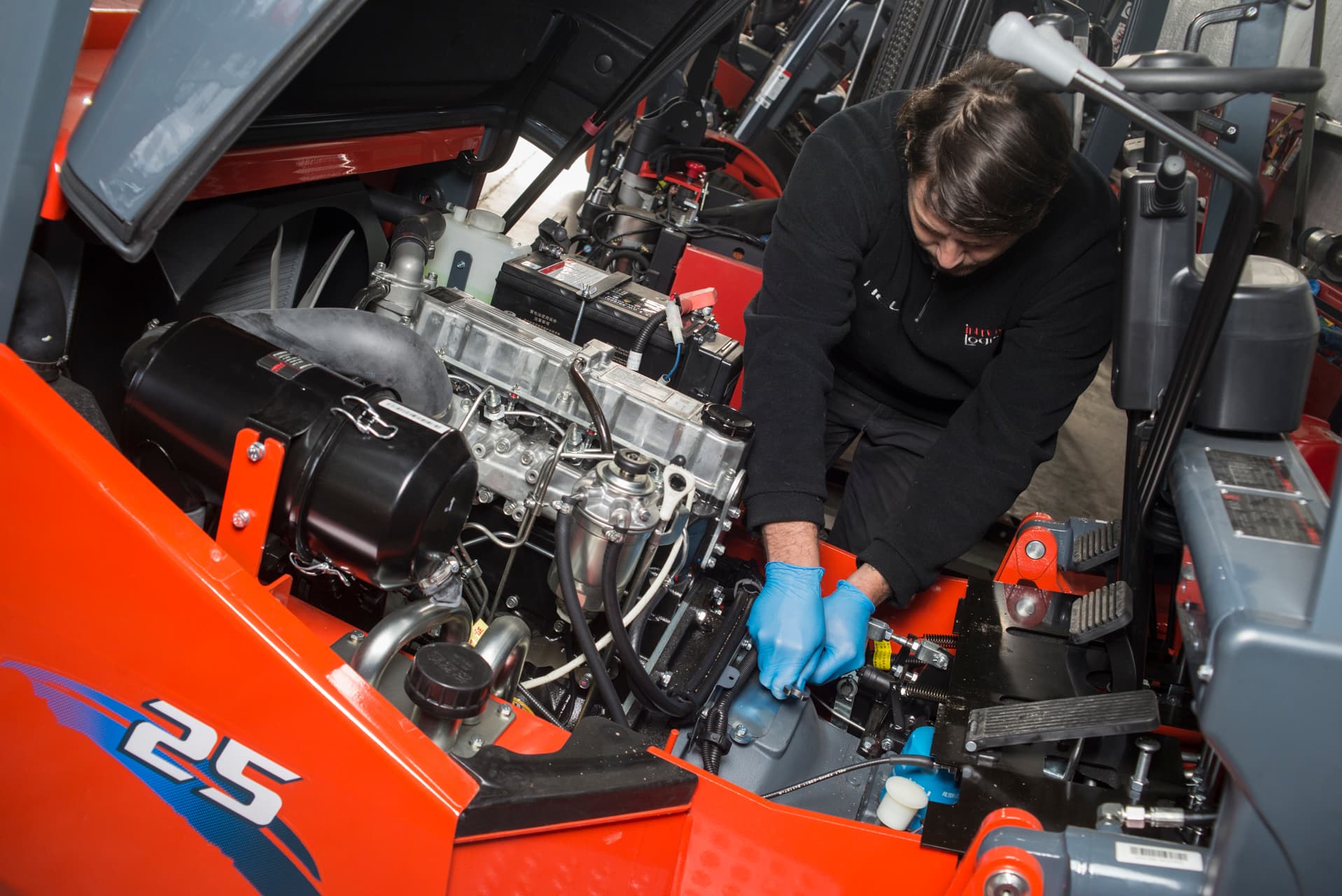
Before starting any shift, the operator must carry out a comprehensive visual and functional inspection of the vehicle, documenting the status of these critical points on a physical or digital checklist:
Category | Inspection Points |
Tires & Wheels | Check for tread wear, deep rubber cuts, and proper inflation pressure. |
Forks & Front End | Verify the correct positioning and locking of the tines or attached handling tool. |
Hydraulic Integrity | Ensure there are zero fluid leaks across hoses, cylinders, and valve fittings. |
Fluid Levels | Verify engine oil, hydraulic fluid, and brake fluid levels are optimal. |
Controls & Electronics | Test the operational response of joysticks, horn, lights, and the backup alarm. |
Braking & Restraints | Test the foot brake, parking brake, and the seatbelt latch mechanism. |
Cabin Setup | Adjust the operator seat position and clean all rearview mirrors for optimal sightlines. |
Conclusion
Rigorous adherence to SRT Resolution 960/15 is far more than a simple regulatory formality; it is the absolute foundation for shielding your workforce from harm, protecting your logistical infrastructure, and extending the operational lifespan of your HELI machinery under world-class productivity metrics.
If you are looking to certify your operators under current legal frameworks, require specialized technical assistance to update your fleet's onboard safety mechanisms, or need to stock up on approved safety components, we invite you to consult our support team. You can reach our technical service department directly by clicking here.
Share
The Interlogistic Team
Specialists in industrial logistics and equipment
.jpg&w=3840&q=75)