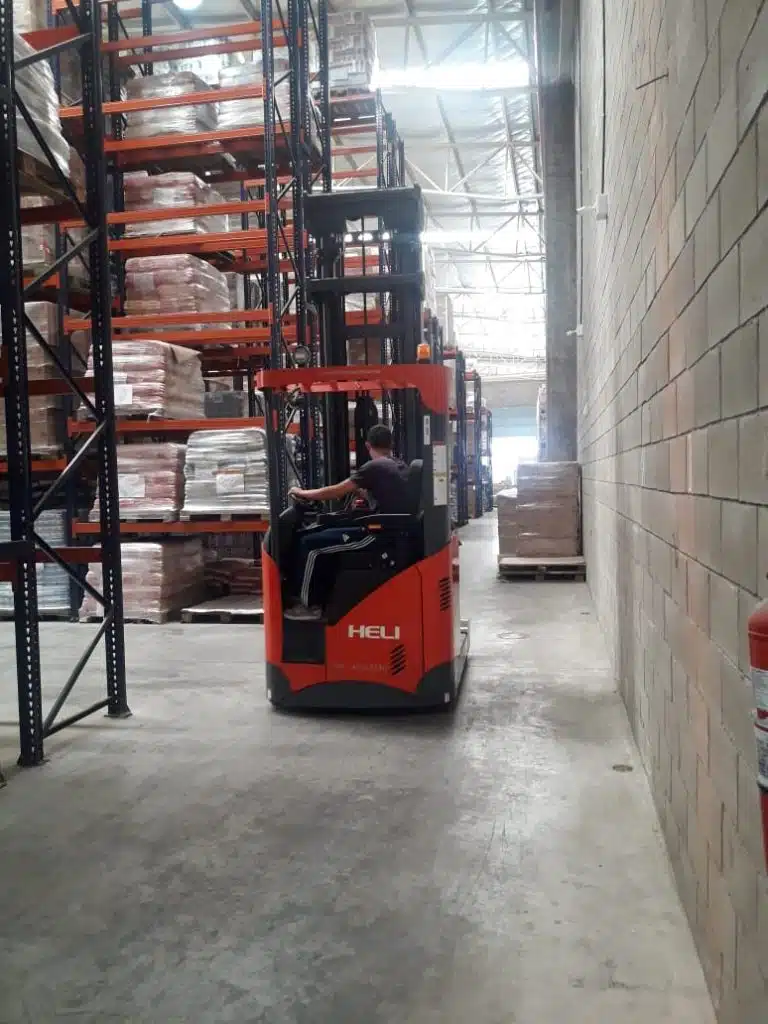
Discover how to use a reach truck and why it is the preferred machine for high-density warehouses. Learn how its moving mast allows operations in narrow aisles and stacks pallets over 10 meters high with maximum precision, safety, and space optimization.
Content
A reach truck, as its name specifies, is an electric machine characterized by performing its turning and lifting maneuvers by retracting the mast, shifting it directly toward the center of the machine's chassis to gain stability during travel.
Currently, reach trucks are the most widely used machines for working inside modern warehouses. They differ significantly from conventional forklifts because they weigh less, achieve higher energy efficiency, and are specifically engineered to maneuver in much narrower aisles.
The Load Mechanism and Moving Mast Operation
Although the masts and forks are structurally similar to those of a standard forklift, the method for picking up or dropping off a pallet on a racking system changes completely to optimize footprint space:
Positioning: The machine positions itself in the center of the aisle, directly facing the load unit or racking module.
Extension: To pick up or deposit the pallet, the mast extends outward (forward), facilitating the stacking maneuver without needing to move the entire vehicle chassis.
Retraction: Once the load is secured on the forks, the mast retracts back into the center of the machine before starting ground-level transport.
High-Altitude Storage (Over 10 meters)
Certain advanced models in the HELI line have the capability to lift loads above 10 meters high. At these critical heights, operator visibility naturally decreases. For this reason, these units offer the possibility of integrating technological assistive devices, such as high-definition cameras and height selectors, ensuring surgical and safe maneuvers on the highest racking levels.
Pallet Management and Outriggers
Reach trucks feature two lower base arms (outriggers) where the front wheels are housed. The way goods are handled directly impacts racking design and layout:
Standard Pallets (800x1200 mm): When picked up from the shorter side, the pallets fit perfectly between both outriggers of the machine. This allows the pallet to lower completely to the ground without colliding with the equipment's base, avoiding any loss of useful height on the rack's first level.
Wider Pallets: If the pallets exceed standard measurements or are picked up from their widest side, transport must be carried out with the load positioned above the base wheels. This forces the enterprise to make a logistics decision: either open slightly wider aisles (to avoid losing rack capacity) or increase the clearance between the top of the floor pallet and the first beam of the rack, sacrificing some vertical storage space.
If you are looking to maximize your warehouse's storage capacity with the latest in narrow-aisle technology, at Interlogistic we provide multiple stacker models tailored to your operation. You can visit our electric stackers section by clicking here.
Share
The Interlogistic Team
Specialists in industrial logistics and equipment
.jpg&w=3840&q=75)