
It is practically certain that you have seen a forklift in action at a factory, a lumber yard, or a logistics center. These compact machines have become the true heart of material handling worldwide due to an unbeatable combination: their capacity to lift and move heavy loads (ranging from 1,000 kg to more than 10,000 kg depending on the model) with extraordinary agility and versatility.
In this guide, we will break down exactly what a forklift is, look at its fundamental parts, and explore how its engine and hydraulic systems interact daily to optimize heavy-duty operations.
What Is a Forklift?
A forklift (also known as a lift truck or montacargas) is a motorized industrial vehicle featuring a massive counterweight in its rear section. Its primary function is to insert a pair of parallel forks beneath consolidated load units—usually arranged on wooden pallets or skids—to lift them, transport them at ground level, or stack them in high-density storage racks.
The introduction of forklifts into production schemes triggered a logistics revolution: a single properly trained operator can now handle material movements that previously required the physical effort of several people, significantly accelerating dispatch times and minimizing stock breakage costs.
Fundamental Parts of a Forklift
To understand the physics behind these machines, we must first identify their most important structural components:
Forks or Tines: The two horizontal, parallel steel arms that enter the lower slots of a pallet to support the weight of the goods from underneath.
Carriage: The rigid steel structure that holds and positions the forks. It features a vertical displacement guided by the mast to place the tines at the exact required height.
Mast or Lift Tower: The vertical guide along which the carriage and forks travel. It can consist of multiple stages (duplex, triplex) to reach different operational heights.
Rear Steering Wheels: Unlike traditional automobiles, forklifts steer from the rear axle. This provides an extremely tight turning radius and superior maneuverability in narrow warehouse aisles.
Counterweight: A massive cast iron block located at the lower rear section of the vehicle. Its mass determines the unit's physical load limit; trying to lift a load that exceeds this weight breaks the equilibrium, causing a forward tip-over.
Operator Cabin: The ergonomic compartment where the driver has access to all travel controls, the steering wheel, and the hydraulic lift and tilt levers.
The Operating Principle: Hydraulics and the Lever
A forklift's operation combines two basic principles of physics and industrial engineering: the principle of the lever and hydraulic energy transmission.
Weight Equilibrium (The Lever)
Mechanically speaking, a lift truck operates much like a see-saw. The front drive axle acts as the pivot point or fulcrum. The load placed on the forks exerts a downward forward force, while the heavy chassis and the iron counterweight exert a backward force. For the equipment to travel with absolute stability, the weight of the rear counterweight multiplied by its distance to the front axle must always be greater than the weight of the suspended load.
Lifting Power (The Hydraulic System)
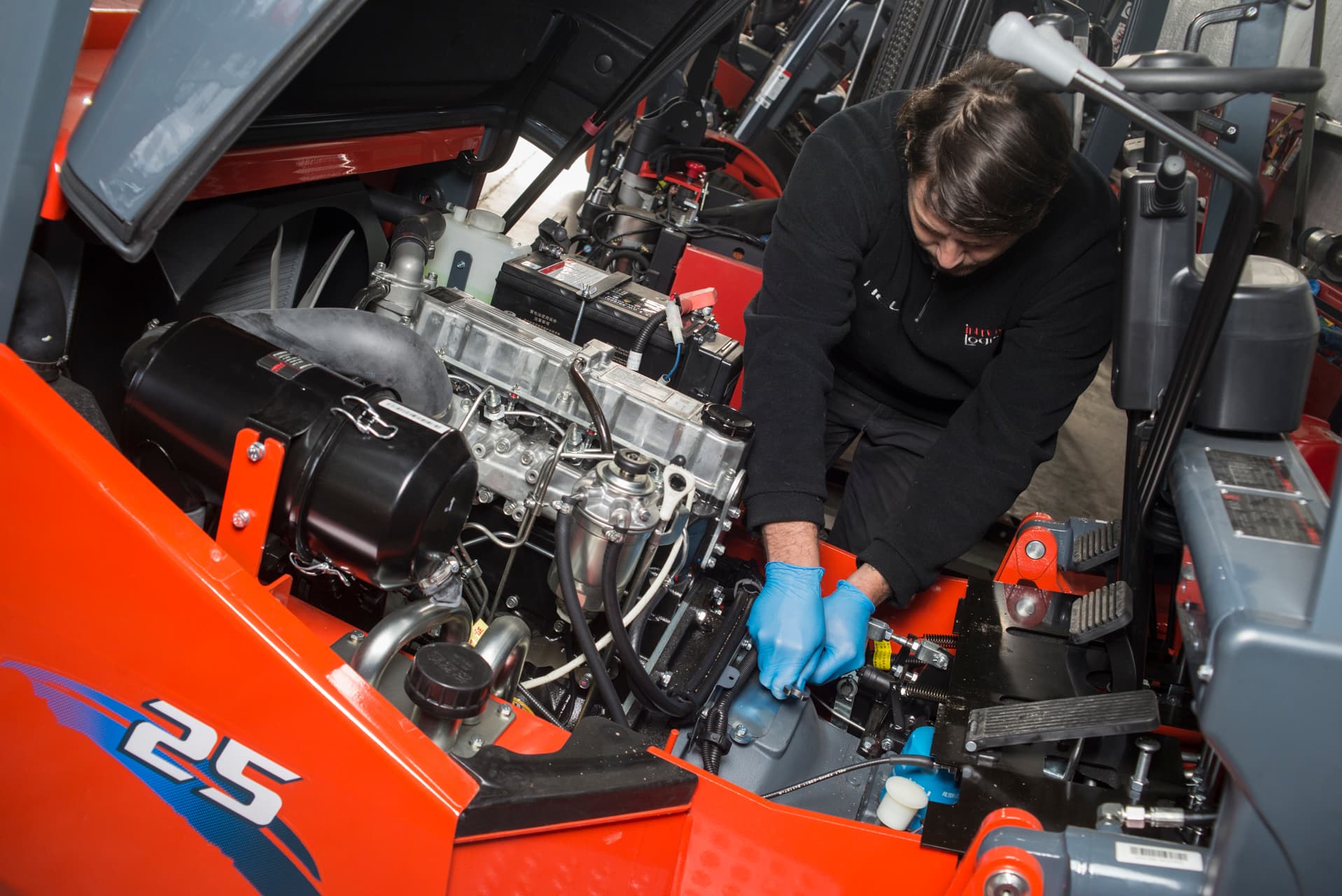
The actual effort required to lift multiple tons relies on a high-pressure hydraulic circuit. When the operator activates the cabin levers, they open or close specific valves that direct high-pressure oil from a hydraulic pump toward the mast's lifting cylinders.
This fluid flow forces the pistons upward. Through a system of high-resistance industrial chains, this movement multiplies and lifts the fork carriage in a smooth, controlled manner. Similarly, additional tilt cylinders allow the mast to pivot forward (to wedge under the pallet) or backward (to secure the load against the backrest during travel).
Safety and Mandatory Operator Training
Because a forklift concentrates a massive amount of weight within compact dimensions and moves around pedestrians, its operation demands strict control. Driving without proper instruction represents a critical risk in any industrial plant, potentially leading to collisions, rack collapses, or severe tip-overs.
This is why regulatory bodies require operators to receive specific theoretical and practical certifications. Operating heavy machinery of this caliber requires mastering residual load charts, performing daily fluid and tire inspections (pre-operational checklists), and knowing how to handle emergency controls.
Conclusion
The forklift is an engineering masterpiece designed to provide strength, speed, and versatility to your business's logistics. Comprehending the components that give it rigidity and the hydraulics that govern its power is the first step toward sustaining an efficient and safe fleet.
If you are looking to modernize your warehouse operations, plan the incorporation of high-end combustion or electric machinery, or need personalized technical advice on our HELI equipment line, you can browse our product catalog by clicking here.
Share
The Interlogistic Team
Specialists in industrial logistics and equipment
.jpg&w=3840&q=75)