The forklift is the main working tool for any warehouse or professional handling heavy loads. For this reason, it is crucial to ensure it is always in perfect operating condition.
Performing preventive maintenance is essential to guarantee worker safety and extend the machine's lifespan. Regardless of whether the forklift is owned or rented, there are a series of critical elements to inspect periodically to ensure its correct operation.
Forklift Inspection: Which Elements to Control?
It is highly necessary to check that everything is in perfect condition after operational shifts. This involves inspecting mainly the following points:
Steering and tires: Both are of vital importance, as they ensure the stability of the machine and, consequently, the load. In the case of wheels, it is not only important to control pressure but also to ensure the tread does not show excessive wear.
Brake system: The condition of the service brakes must be checked daily, paying special attention to the correct operation of the handbrake (parking brake).
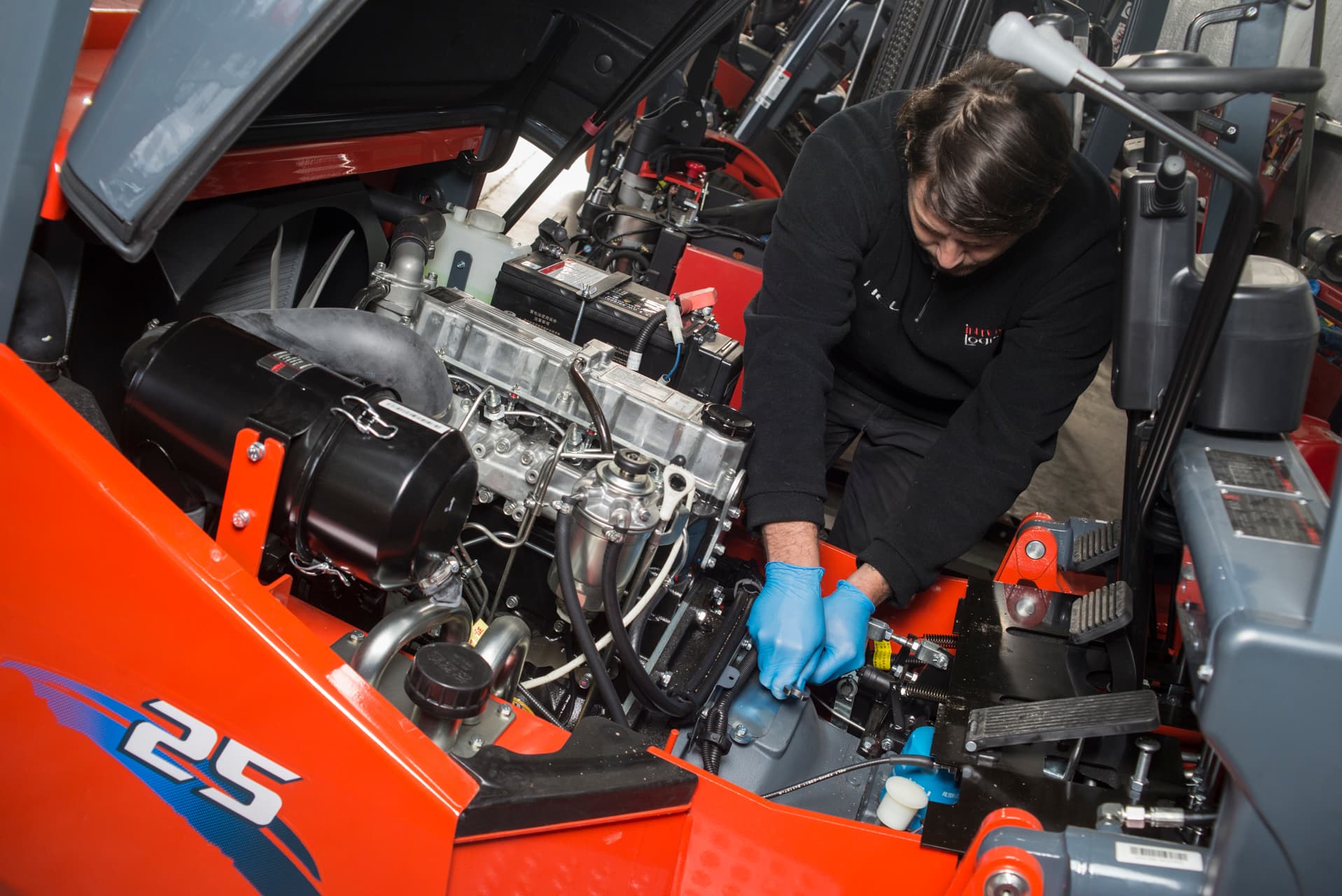
Strange noises and engine: Any sound out of the ordinary can mean a breakdown in the engine or the exhaust pipe (in internal combustion equipment). It is a key indicator to contact technical service immediately.
Signaling and lighting indicators: Controlling driving lights, horns, and beacons is a critical point to maintain safety conditions within the workspace.
Wear of load elements: Whether on the forks or the mast, it is vital to respect the maximum load capacity the equipment supports. Exceeding the expected capacity could cause the pallet to tip over, resulting in serious damage to the merchandise, the operator, and the machine.
💡 Expert Recommendation: It is essential that these in-depth reviews are carried out by an official technical service that has specific brand knowledge, adequate diagnostic tools, and certified safety training.
How Often Should the Service Be Performed?
Scheduled maintenance plans are calculated according to the equipment's hour meter. Standard preventive service is performed every 250 working hours. Therefore, your mandatory programming should follow the intervals of 250 / 500 / 750 hours.
Always keep in mind that when the machine reaches major milestones such as 1,000 / 2,000 / 4,000 hours worked, deep corrective and predictive maintenance is added to the preventive service, which can be carried out directly at your plant or in the specialized workshops of Interlogistic.
What Data Do You Need to Request a Technical Appointment?
To speed up assistance and ensure that technicians attend with the correct tools and genuine spare parts, keep the following at hand when requesting service:
The exact model of the equipment.
The number of hours worked (data shown on the dashboard).
The serial number of the machine or engine number.
Advantages of Preventive Maintenance
An unexpected breakdown can affect the correct operation of the entire warehouse. If a key machine stops working, picking or dispatch activities are temporarily suspended, representing a consequent loss of productivity and money.
Thanks to periodic preventive maintenance, both of the machine and the battery, it is possible to extend the lifespan of your forklift, anticipating major failures that are much more expensive to fix.
If you want to request a technical appointment for your equipment's maintenance or learn more about our preventive programs, you can visit our technical service section by clicking here.
Share
The Interlogistic Team
Specialists in industrial logistics and equipment
.jpg&w=3840&q=75)